
For decades, crude oil meant one thing for most people — petrol and diesel.
But Reliance Industries now wants to tell a different story.
Speaking about the company's future direction, Reliance Chairman Mukesh Ambani outlined an ambitious plan that goes far beyond refining fuel. Instead of focusing only on traditional oil products, the company wants to convert much of the crude it processes into high-value chemicals, advanced materials and greener products that could shape industries of the future.
Behind the technical language lies a much bigger story — one about jobs, manufacturing and India's attempt to build a cleaner industrial economy.
The world is changing rapidly. Electric vehicles are slowly reducing dependence on petrol and diesel, while countries and companies are searching for cleaner and more sustainable industries.
Reliance believes the answer lies in turning its giant refining ecosystem into a materials and chemicals powerhouse.
That means producing products such as carbon fibre, specialty materials and green chemicals that are used in sectors ranging from renewable energy and batteries to aerospace and advanced manufacturing.
Instead of seeing crude oil only as fuel, the company wants to extract greater value from every barrel.
For thousands of young Indians, the announcement carries another meaning: jobs.
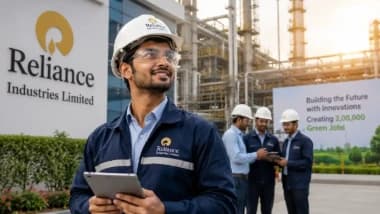
Reliance says its new energy and materials businesses could create around 2 lakh green jobs in the coming years. These opportunities are expected to span manufacturing, engineering, research, technology, operations and supply chains.
Much of this activity will be centered around Gujarat, where massive clean energy facilities and manufacturing complexes are taking shape.
For engineers graduating today, the jobs of tomorrow may look very different from those of previous generations. Skills linked to batteries, solar manufacturing, hydrogen technologies and advanced materials are likely to become increasingly important.
Reliance's strategy is not simply about replacing one business with another.
The company aims to repurpose its existing infrastructure instead of abandoning it, extending the life of assets while moving toward lower-carbon businesses. The broader goal is to create a circular and sustainable materials ecosystem while reducing exposure to volatile energy markets.
The transition will not happen overnight. Large-scale investments, new technologies and global partnerships will all be required.
But the direction is becoming clearer.
The company that once transformed India's telecom sector with Jio is now attempting another long-term reinvention — this time in energy, chemicals and advanced materials.
Whether the bet succeeds will unfold over years, not quarters.
But for India, the larger significance may lie elsewhere.
The future of oil may not only be about what we burn in our vehicles.
It may increasingly be about what we build with it.