
We’ve all been there: an unexpected car repair, a sudden medical bill, or just the desire to consolidate a few lingering credit card debts. In those moments, personal loans look like a lifeline. And if you open a modern instant-loan app, they make it feel like magic. Two clicks, an upload of your IDs, and boom the money is in your account.
But there’s a massive difference between what an app tells you, you can borrow and what your budget can actually handle.
Before you ever hit "Apply," you need to pull back the curtain on the numbers. That starts with a personal loan calculator. But more importantly, it requires understanding how fintech apps use psychology and hidden fees to charge you far more than a traditional bank, spinning a web of Equated Monthly Investments (EMIs) that can quickly become painful.
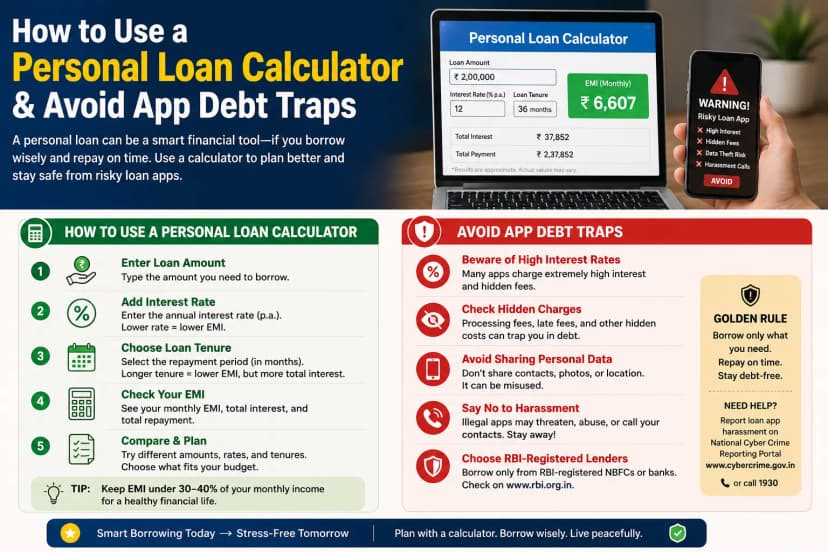
When you look at a standard personal loan or EMI calculator online, it asks you for three simple inputs:
- Loan Amount (Principal): The total cash you want to borrow.
- Interest Rate: The annual percentage rate (APR) charged by the lender.
- Tenure: How many months or years you take to pay it back.
The calculator spits out your monthly payment using a standard mathematical formula:
EMI = [P × r × (1 + r)ⁿ] ÷ [(1 + r)ⁿ - 1]
Where P is the principal, r is the monthly interest rate (annual rate divided by 12), and n is the number of monthly installments.
Lenders love to fiddle with the tenure slider to make a loan look attractive. If you borrow 5,00,000 ₹ at a 12% interest rate, a 2-year tenure means a steep monthly payment of roughly 23,537 ₹.
If you drag that slider out to 5 years, your monthly payment drops to a highly manageable 11,122 ₹.
The catch?
- • On the 2-year loan, you pay 64,893 ₹ in total interest.
- • On the 5-year loan, you pay 1,67,333 ₹ in total interest, nearly triple the cost of borrowing the exact same amount of money.
Always use the calculator to find the shortest possible tenure you can safely afford, rather than chasing the lowest monthly payment.
Instant loan apps have revolutionized borrowing, but that speed comes at a steep premium. While a traditional bank might put you through a rigorous background check and take 3 to 7 business days to approve a loan at 10.5% to 14% interest, an app might approve you in 60 seconds.
Here is exactly how those apps silently extract more money from your pocket:
Traditional banks usually charge a flat processing fee or a small percentage (e.g., 1% to 2% capped at a certain amount). Instant apps routinely charge 3% to 6% upfront. If you are approved for 1,00,000 ₹, the app might deduct a 5,000 ₹ processing fee plus tax right out of the gate. You only receive 95,000 ₹ in your bank account, but you are still paying interest on the full 1,00,000 ₹.
This is the oldest trick in the book. A bank almost always uses a reducing balance method, where your interest is calculated on the remaining unpaid loan balance each month. As you pay off the principal, the amount of interest you owe drops.
Many apps advertise a "flat rate" because it sounds lower. For example, a "8% flat rate" sounds better than a "13% reducing rate." However, with a flat rate, you pay interest on the entire initial loan amount for the whole duration, even when you only owe a fraction of it left. That 8% flat rate can actually equate to an effective APR of nearly 15%.
Before you click submit on an app, there are often pre-checked boxes for "loan protection insurance," "convenience fees," or "document verification charges." These can add thousands to the loan baseline before the interest even kicks in.
The real danger of app-based borrowing isn't just the higher cost, it’s the structural slippery slope that leads to a debt trap. Investigative reports over the last few years have highlighted how quickly small digital loans turn into compounding nightmares.
Because instant apps target speed and convenience, their repayment windows are often incredibly tight, sometimes just 15 to 90 days for smaller micro-loans, or 12 months for larger ones.
- The Cash Crunch: Because the effective interest and upfront fees are so high, the actual monthly hit to your paycheck is larger than expected.
- The "Pre-Approved" Temptation: The moment you struggle or look like you might miss a payment, the app's algorithm detects it, or competing apps target your credit profile. They offer an instant "top-up" loan or a secondary loan to "help you clear your current dues."
- The Rollover Trap: When you use Loan B to pay off Loan A, you are paying processing fees twice, interest on top of interest, and your disposable income shrinks even further. Within three to four months, a borrower can easily find themselves managing four different EMIs across three apps, with 40% of their salary vanishing the day it hits the account.
To keep your finances firmly in the green, use this mental checklist before signing any digital loan agreement:
- • Calculate your Debt-to-Income Ratio: Total up all your current monthly obligations (rent, existing credit cards, education loans). If a new personal loan EMI pushes your total debt payments above 40% of your net monthly take-home pay, your eligibility drops with major banks, and your financial risk skyrockets.
- • Verify the APR, not the Interest Rate: Demand to see the Annual Percentage Rate (APR). The APR is the only number that factors in the interest rate plus processing fees, administrative costs, and upfront deductions. It gives you the true, honest cost of the loan.
- • Look at the Foreclosure Charges: If you get a bonus or an unexpected windfall, you’ll want to pay off the loan early. Traditional banks often allow this for free after a certain number of EMIs. Many instant apps charge massive foreclosure penalties (up to 4-5% of the remaining principal) because they don't want to lose out on your future interest payments.
The Golden Rule: If you cannot calculate the total cost of ownership on a loan using a standard transparent EMI calculator, do not borrow the money. Speed is rarely worth the price of long-term financial peace of mind.