
Ask almost any salaried professional in India about tax planning, and you'll hear a familiar response: "I've already used my 80C limit."
For many people, tax planning begins and ends with investing ₹1.5 lakh in options like PPF, ELSS funds, or their employer's EPF contribution. Once that's done, they assume they've exhausted all meaningful tax-saving opportunities and move on.
The reality is that India's tax system offers several other deductions, exemptions, and planning strategies that often go unnoticed. By focusing only on Section 80C, many taxpayers end up paying more tax than necessary and miss opportunities to improve both their savings and long-term financial health.
If you're in the 30% tax bracket, relying only on Section 80C could mean missing out on significant tax savings. Many salaried professionals complete their ₹1.5 lakh investments and assume their tax planning is done, even though several valuable deductions remain unused.
While most people focus on the same set of tax-saving investments, informed taxpayers under the Old Tax Regime often take advantage of additional deductions that can substantially reduce their tax liability.
Here are three completely legal and often overlooked ways to save more income tax beyond Section 80C.
Many salaried professionals assume that once they have exhausted their ₹1.5 lakh Section 80C limit, there are no major tax-saving options left. That's not entirely true.
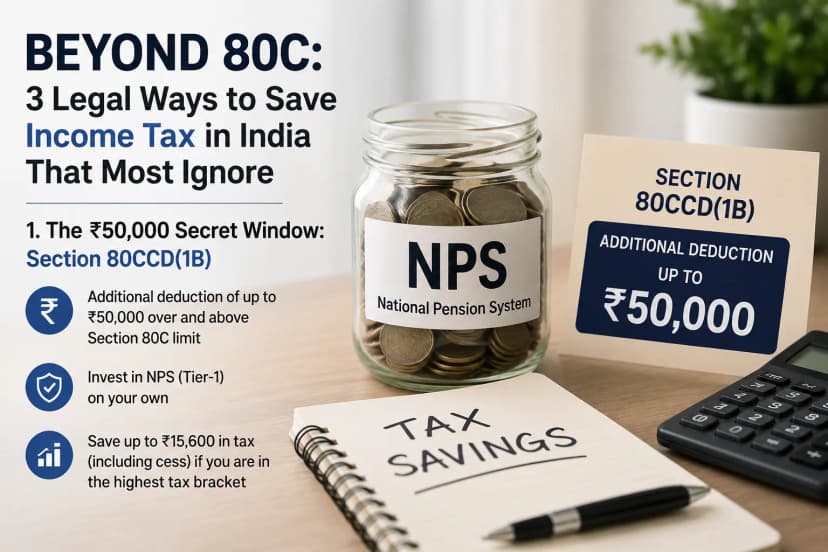
The National Pension System (NPS) offers a separate tax deduction under Section 80CCD(1B), allowing you to claim an additional deduction of up to ₹50,000 over and above the 80C limit. This makes it one of the few tax-saving opportunities that doesn't compete with your existing PPF, ELSS, EPF, or life insurance investments.
How it works: Open an NPS Tier-I account and make a voluntary contribution during the financial year. The amount invested, up to ₹50,000, can be claimed as an additional deduction while filing your income tax return.
- • Why it matters: For someone in the 30% tax bracket, this extra deduction can reduce the tax bill by up to ₹15,600, including cess. It's a simple, legal, and often overlooked way to save more tax after maxing out Section 80C.
This is perhaps the most underutilized strategy for young professionals living in metro cities. If your corporate salary structure includes House Rent Allowance (HRA) but you are currently staying with your parents, you are likely letting that HRA component get heavily taxed.
You can legally fix this by restructuring your living arrangement into a formal landlord-tenant relationship.
- • How to play it: Draw up a legitimate rent agreement with your parents and physically transfer the rent into their bank account every month. You can then submit these rent receipts to your HR to claim your HRA exemption.
- • The Catch (and why it works): This rent will be treated as income for your parents. However, if your parents are retired or fall into a much lower tax bracket than you, the family's net tax liability plummets. Furthermore, under Section 24(a), your parents get a flat 30% standard deduction on that rental income for "repairs and maintenance"—meaning they only pay tax on a portion of what you give them, while you save on the full amount.
Almost every corporate employee knows that health insurance premiums save tax under Section 80D. The mistake most make is treating it like a flat, one-time checkbox. They cover themselves, get a small deduction, and look no further.
Section 80D is actually a modular matrix designed to reward you for covering your extended family, and the limits stack up significantly.
| Who You Insure | Age Bracket | Maximum Annual Deduction |
| Self, Spouse, & Dependent Kids | Under 60 Years | Option 1: ₹25,000 |
| Parents | Under 60 Years | Option 2: Additional ₹25,000 |
| Parents (Senior Citizens) | 60 Years or Older | Option 3: Additional ₹50,000 |
By taking over the medical insurance premiums for senior citizen parents, your total eligible deduction under Section 80D jumps from a modest ₹25,000 to a massive ₹75,000.
The Quick Cash Trick: Tucked inside this section is a tiny sub-limit that almost everyone ignores: Preventive Health Check-ups. The government allows you to claim up to ₹5,000 within the overall caps for routine blood tests, master health checkups, or regular diagnostics. If you have any medical test bills from the past year that you paid for in cash or online, keep those receipts—they can quickly fill the gaps if your premium didn't fully exhaust the limit.
| Section | What You Do | Maximum Cap | Best Suited For |
| 80CCD(1B) | Voluntary NPS Tier-1 Deposit | ₹50,000 | High earners who want a secure retirement top-up. |
| 10(13A) | Pay HRA Rent to Parents | Based on basic salary | Salaried folks living in parental homes. |
| 80D | Health Insurance + Annual Health Checks | Up to ₹1,00,000 | Anyone supporting aging or senior citizen parents. |
A quick word of warning: Tax laws are heavily dependent on which door you walk through. These deductions are highly lucrative, but they apply exclusively if you stick with the Old Tax Regime. If you’ve migrated to the New Tax Regime for its lower structural slab rates, these deductions are stripped away. Always do the math on your specific CTC before choosing your side.