
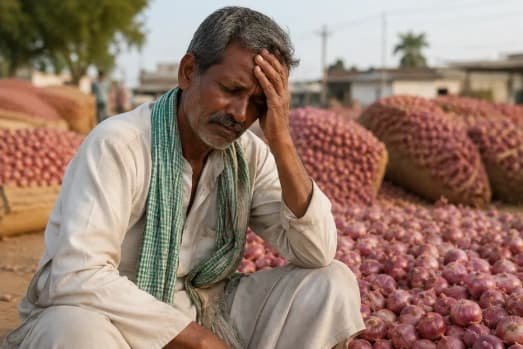
For a farmer who wakes up at dawn, breaks his back in the mud, and battles the whims of unpredictable weather, the onion is never just a vegetable. It represents months of sweat, heavily borrowed capital, and the hope of feeding his own family. But for decades, the volatile onion market in India has been a source of deep heartbreak, frequently turning a bumper harvest into a financial nightmare overnight.
In a fresh bid to ease some of this distress, the Central Government has stepped in with a policy tweak. Starting today, Saturday, June 13, 2026, the government has officially raised the Minimum Assured Procurement Price (MAPP) for onions under its buffer stock programme to ₹16.50 per kg (or ₹1,650 per quintal), up from the previous rate of ₹15.80 per kg.
The decision, reviewed and finalized by Union Food and Consumer Affairs Minister Pralhad Joshi, aims to push more money directly into the pockets of struggling growers while balancing the scales of inflation for the everyday consumer.
While a price hike on paper sounds like a step in the right direction, the view from the ground—especially in Nashik, Maharashtra, the undisputed onion capital of India—reveals a much tougher reality.
To understand the farmers' sentiment, one has to look at the math behind the crop. Rising fuel prices, expensive fertilizers, labor charges, and transportation costs have drastically driven up the cost of cultivation. For a typical farmer in Maharashtra, it costs anywhere upwards of ₹1,800 to ₹2,000 just to produce a single quintal of storage-grade onions.
Because of this, farming unions and regional growers’ associations have been actively demanding a procurement rate of ₹30 per kg (₹3,000 per quintal).
What the Growers Are Saying:
"Even with the revised rate, we are barely breaking even—in fact, many are still operating at a loss," notes the collective sentiment from Maharashtra’s state onion grower groups. When open market mandis (local wholesale markets) offer quicker, cash-in-hand transactions within 24 hours, government procurement centers face a tough time attracting farmers, especially when official channels involve bureaucratic paperwork and a 15-to-30-day waiting period for bank transfers.
The government's procurement target for this season has been adjusted to 2 lakh tonnes, a step down from the 3 lakh tonnes procured in the previous cycle. This crop is accumulated under the Price Stabilisation Fund (PSF).
The mechanism works like a giant atmospheric valve for the economy:
- • During Harvest Gluts: When the market is flooded and prices crash, central agencies like NAFED and NCCF step in to buy directly from farmers, putting a floor under falling prices.
- • During Scarcity: When supplies dry up in the winter and retail prices skyrocket for the urban consumer, the government releases these stored buffer stocks into cities to keep kitchen budgets from collapsing.
According to the latest agricultural data, India’s total onion production for the 2025-26 cycle is estimated at 307.37 lakh tonnes—fractionally lower than the previous year's 307.67 lakh tonnes. With production remaining stable but input costs rising sharply, the margins for the average farmer have become dangerously thin.