
Every year, around tax season, a familiar collective anxiety grips the Indian middle class. We sit down with our salary slips, pull up an excel sheet, and ask ourselves the exact same question: “Am I losing money by picking the wrong tax regime?”
Following the rollout of the sweeping Income Tax Act, 2025—which officially kicked in on April 1, 2026—the government has streamlined the language of tax laws and replaced the traditional "Assessment Year" and "Financial Year" with a singular, unified "Tax Year 2026-27."
While the administrative language has changed completely, the actual tax slabs have remained stable. The default option is still the New Tax Regime, packaged with highly aggressive tax rebates for middle-income earners.
If you are trying to figure out where your hard-earned money stays safest this year, let's break down the math behind the New and Old regimes cleanly and visually.
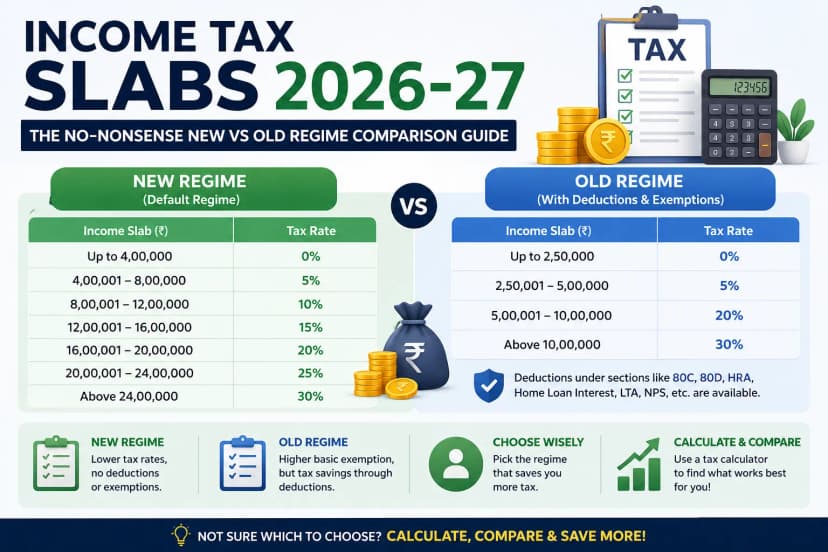
The fundamental difference remains unchanged: The New Regime offers significantly lower tax rates but strips away almost all traditional deductions. The Old Regime sticks to higher tax rates but lets you scale down your taxable income if you actively invest in tax-saving instruments.
Here is how the slabs stack up side-by-side for an individual under 60 years of age:
| Income Range (New Regime) | New Regime Rate | Income Range (Old Regime) | Old Regime Rate |
| Up to ₹4,00,000 | NIL | Up to ₹2,50,000 | NIL |
| ₹4,00,001 – ₹8,00,000 | 5% | ₹2,50,001 – ₹5,00,000 | 5% |
| ₹8,00,001 – ₹12,00,000 | 10% | ₹5,00,001 – ₹10,00,000 | 20% |
| ₹12,00,001 – ₹16,00,000 | 15% | Above ₹10,00,000 | 30% |
| ₹16,00,001 – ₹20,00,000 | 20% | Note: Slabs remain flat above ₹10L in old | |
| ₹20,00,001 – ₹24,00,000 | 25% | ||
| Above ₹24,00,000 | 30% |
Takeaway: Notice the steep jump in the Old Regime. The moment your taxable income crosses ₹10 Lakh, every extra rupee is taxed at a heavy 30%. In contrast, the New Regime spreads those steps out much more gradually, hitting 30% only after you pass ₹24 Lakh.
The biggest selling point of the New Tax Regime is the massive extension of the Section 87A rebate. If your net taxable income does not exceed ₹12 Lakh, your calculated tax liability is fully offset by a rebate of up to ₹60,000.
For a salaried professional, this creates a beautiful sweet spot that pushes the effective tax-free limit all the way up to ₹12.75 Lakh. Here is exactly how that math works out:
1.Start with Gross Salary:Initial Baseline.Assume your total gross salary for the year is exactly ₹12,75,000.
2.Apply the Standard Deduction:Minus ₹75,000.The New Regime provides a flat ₹75,000 standard deduction for salaried individuals. Subtracting this brings your Net Taxable Income down to exactly ₹12,00,000.
3.Calculate Progressive Slab Tax:Gross Liability: ₹60,000.Your tax on ₹12 Lakh is calculated using the progressive slabs:
- • First ₹4 Lakh: NIL
- • ₹4 Lakh to ₹8 Lakh (5% of ₹4L): ₹20,000
- • ₹8 Lakh to ₹12 Lakh (10% of ₹4L): ₹40,000
- • Total Calculated Tax = ₹60,000
4.Trigger the Section 87A Rebate:Net Payable: ₹0.Because your final net taxable income did not cross the ₹12,00,000 threshold, the government awards you a full tax rebate of ₹60,000, reducing your final income tax liability to absolutely NIL.
If you go down the Old Regime path, you have to be ready to manage paperwork and actively lock your money away. Here is a breakdown of what you can and cannot claim between the two paths:
| Feature / Benefit | New Tax Regime | Old Tax Regime |
| Standard Deduction (Salaried) | ₹75,000 | ₹50,000 |
| Section 80C (PPF, EPF, ELSS, Life Ins.) | Disallowed | Allowed (Up to ₹1.5 Lakh) |
| Section 80D (Health Insurance Premium) | Disallowed | Allowed (Up to ₹25k / ₹50k) |
| House Rent Allowance (HRA) | Disallowed | Allowed |
| Home Loan Interest (Self-Occupied) | Disallowed | Allowed (Up to ₹2 Lakh) |
| Max Surcharge Rate (High Net Worth) | Capped at 25% | Up to 37% |
There is no single "correct" answer, but there is a clear thumb rule based on your saving habits:
- • Choose the New Regime if: You prefer immediate liquidity, do not want to lock your money up in insurance policies or long-term funds just to save tax, or earn up to ₹12.75 Lakh as a salaried employee. It offers a much higher disposable income to invest freely.
- • Choose the Old Regime if: You are already paying off a home loan (claiming Section 24b), live in a rented apartment with a massive HRA component, and easily exhaust your 80C and 80D limits. For high-earning heavy savers, the old system can still yield massive tax savings if total deductions exceed roughly ₹3.5 Lakh to ₹4 Lakh.
Since the New Regime is now the standard default option, your payroll team will automatically calculate your TDS based on it unless you explicitly submit a declaration choosing the Old Regime at the start of the year. Take a few minutes to run your exact numbers through an online calculator before making the final call.