
Geopolitics and global economics often feel like a game played on maps by abstract powers, completely detached from the ordinary citizen. But every time we pull into a local petrol pump, the global undercurrents show their face.
Behind the steady hum of India's massive refining hubs, a critical partnership is quietly intensifying. According to the latest data compiled by the European think tank, the Centre for Research on Energy and Clean Air (CREA), India firmly held its ground as the world's second-largest buyer of Russian fossil fuels.
Driven by an absolute necessity to secure affordable energy for over a billion consumers, Indian refiners stepped up their purchases significantly. In total, India imported a staggering €5.8 billion (approximately $6.7 billion) worth of Russian hydrocarbons.
This isn’t just a macro-economic trend; it’s a living, breathing operation visible across India's coastline. When you look closely at the numbers, crude oil made up the massive lion's share—about 83%—of these imports, translating to €4.8 billion. The rest of the shipments were rounded out by coal and various oil products.
What is truly striking is the velocity of this shift. India’s overall appetite for crude oil rose by 8%, but the intake specifically from Russia shot up by 21%.
| Rank | Country / Region | Export Share |
| 1 | China | 50% |
| 2 | INDIA | 36% |
| 3 | Turkiye | 6% |
| 4 | European Union (EU) | 5% |
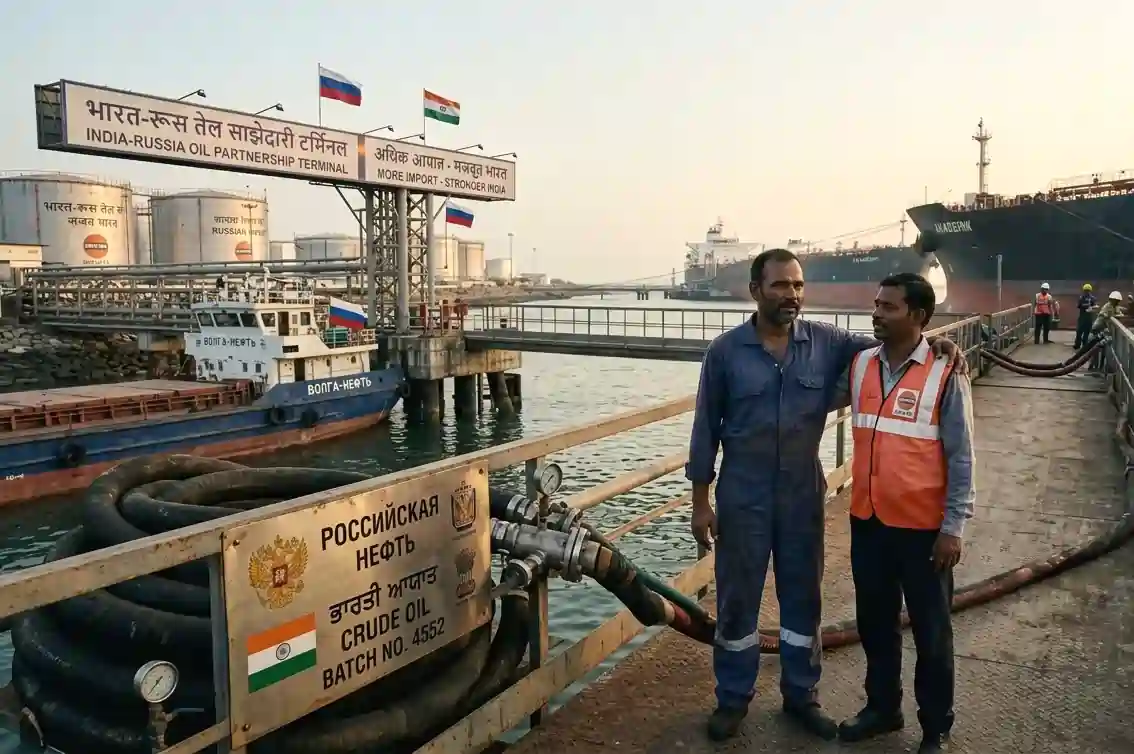
The physical manifestation of this buying surge can be seen at major port facilities across the country:
- • Gujarat's Hubs: Tanker arrivals at the Vadinar refinery jumped by 36%, while the massive Jamnagar refining complex clocked a 14% rise in incoming Russian barrels.
- • State-Run Comebacks: Government-owned refineries that had temporarily paused their intake towards the end of last year are back in full swing. Deliveries to New Mangalore climbed 13%, while Visakhapatnam witnessed a massive 42% spike.
- • East Coast Peak: On the eastern seaboard, Odisha's Paradip refinery quietly unloaded its highest volume of Russian crude in two full years.
Here is where the story takes a fascinating, deeply human turn. While Western nations have publically imposed stringent trade restrictions and embargoes on Moscow, the global energy ecosystem cannot simply be turned off like a light switch.
The data reveals an intricate paradox: the very countries enforcing sanctions are frequently buying the finished product back. Refineries in countries like India, Turkiye, and Brunei process the raw Russian crude into transportable fuels like diesel and petrol. These processed products—now legally transformed—are shipped straight back to the West.
During this period alone, these processing nations exported €641 million worth of refined oil products back to sanctioning states. The buyers? The European Union itself accounted for €174 million, Australia took €275 million, and the United States brought in €147 million. In fact, tracked shipments bound for the US originated directly out of Reliance Industries' Jamnagar facility, which relies on Russia for a notable portion of its raw feedstock.
At its core, this dynamic isn't about defying Western diplomacy or picking sides on a global stage. For India, a country that relies on imports for over 80% of its domestic oil requirements, energy security is a matter of survival, economic stability, and basic human welfare.
By consistently securing discounted and steady energy blocks, domestic refiners manage to insulate everyday citizens from catastrophic spikes in transport and logistics costs. It keeps the local trucks moving, the manufacturing units humming, and public transport affordable.
While international treaties twist and turn, India’s underlying energy strategy remains firmly anchored in a single, unyielding human priority: keeping the country's lights on and the economy moving at a price its people can afford.