
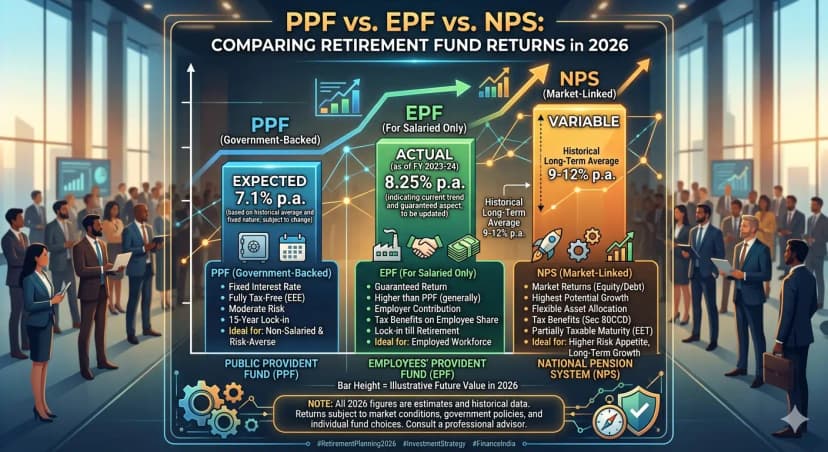
When you are building your long-term wealth, picking the right retirement basket can feel incredibly overwhelming. India offers three heavyweights for retirement savings: the Public Provident Fund (PPF), the Employees' Provident Fund (EPF), and the National Pension System (NPS).
While all three are excellent tax-saving tools, they operate on completely different engines. One offers guaranteed safety, one is a solid corporate companion, and the third hitches its wagon to the stock market.
Let's cut through the financial jargon and analyze how these three options stack up against each other right now, in 2026, so you can decide exactly where your hard-earned money belongs.
Before diving into the math of returns, let’s understand what these funds actually are and how much flexibility they give you.
| Feature | Public Provident Fund (PPF) | Employees' Provident Fund (EPF) | National Pension System (NPS) |
| Who can invest? | Every Indian citizen (Self-employed or salaried) | Salaried individuals only | Every Indian citizen |
| Risk Level | Zero Risk (Government Guaranteed) | Zero Risk (Government Guaranteed) | Market-linked (Low to Moderate Risk) |
| Max Investment | ₹1.5 Lakh per year | No upper limit (Tax rules apply above ₹2.5L) | No upper limit |
| Lock-in Period | 15 Years | Until retirement / job switch | Until age 60 |
| Tax Status | EEE (Exempt-Exempt-Exempt) | EEE (With limits on high contributions) | EET (Maturity lump sum is free, pension taxable) |
Returns are the ultimate metric when you are planning a retirement corpus. Here is where the absolute difference lies between guaranteed debt assets and market-linked equity instruments.
The PPF rate is reviewed by the government every quarter. For a long time, it has held steady around 7.1% per annum, compounded annually.
- • The Reality: While 7.1% sounds modest compared to a roaring stock market, you must remember its EEE (Exempt-Exempt-Exempt) status. The interest you earn is 100% tax-free. If you fall under the highest tax bracket, a tax-free 7.1% return behaves like a taxable fixed deposit yielding over 10%. It’s a rock-solid, zero-risk foundation for your portfolio.
EPF continues to be one of the most attractive debt instruments for salaried individuals, historically offering interest rates hovering around 8.15% to 8.25%.
- • The Reality: EPF comfortably beats PPF on pure interest numbers. It benefits from compound interest over decades of employment. However, remember that if your personal contribution towards EPF exceeds ₹2.5 Lakh in a financial year, the interest earned on the excess amount becomes taxable. For the vast majority of salaried professionals, it remains a phenomenal compounding machine.
NPS does not have a fixed rate of return because your money is actively invested in a mix of corporate bonds, government securities, and equity (stocks). If you choose the "Active Choice" option, you can allocate up to 75% of your portfolio into Equities (Scheme E).
- • The Reality: Because of its equity exposure, the NPS has hands-down delivered the highest returns over long cycles. Over a 10-to-15-year horizon, aggressive NPS portfolios with high equity exposure have comfortably delivered 10% to 12% annualized returns.
- • The Catch: It is market-linked. If the market goes through a correction phase right when you hit retirement, your corpus fluctuates. Furthermore, at age 60, you can only withdraw 60% of the corpus as a tax-free lump sum; the remaining 40% must be used to purchase an annuity (pension), which is taxable as per your income tax slab.
All three accounts help you reduce your tax liability, but they do it quite differently.
- • PPF & EPF: Both fall under the standard Section 80C umbrella, capped at a maximum deduction of ₹1.5 Lakh per year.
- • NPS Exclusive Benefit: This is where NPS steals the spotlight. Over and above the ₹1.5 Lakh limit of Section 80C, you get an exclusive additional deduction of ₹50,000 under Section 80CCD(1B). If you are in the 30% tax bracket, investing ₹50,000 here saves you an extra ₹15,000 straight away in taxes every single year.
There is no one-size-fits-all winner. The best approach is to treat these funds as pieces of a puzzle rather than rivals.
You are a conservative investor, self-employed, or simply want a completely tax-free, zero-risk safety net where the government guarantees your maturity amount. It’s an excellent choice to lock in money for milestones that are 15 years away (like a child's higher education).
You are salaried. Let this run in the background automatically. Try not to withdraw from your EPF account during job switches, as the long-term compounding effect on an 8.2% rate is incredibly powerful for building your core retirement base.
You have a long time left before retirement (10+ years) and you want your money to beat inflation by riding the growth of the Indian stock market. The additional ₹50,000 tax deduction is a massive bonus that you should ideally take advantage of regardless of your risk profile.
The Golden Rule: A smart retirement plan combines the safety of EPF/PPF with the growth potential of NPS. By balancing guaranteed fixed returns with market-linked upside, you build a retirement portfolio that can withstand inflation without giving you sleepless nights.