
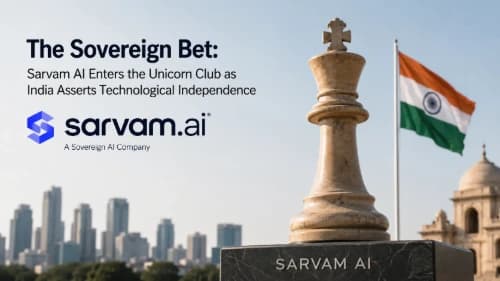
The global race for artificial intelligence has shifted from a corporate turf war to a matter of national sovereignty. For months, tech-policy circles have quietly worried about India's reliance on Western foundational AI models. Those anxieties sharpened into urgency after global policy shifts cut off certain advanced international models from non-US users.
Against this tense backdrop, Bengaluru-based Sarvam AI has effectively drawn a line in the sand.
The homegrown startup officially closed a massive $234 million in the first tranche of its Series B funding round, thrusting it into the unicorn club with a post-money valuation of $1.5 billion. The landmark deal represents one of the largest single fundraises for a pure-play Indian AI venture to date.
What makes this specific funding round standout isn't just the sheer number of zeroes on the check—it's the strategic configuration of the backers.
Indian IT services behemoth HCLTech acted as the primary driver, anchoring the round with a massive $150 million investment to secure an approximate 10.5% equity stake. Global venture capital heavyweight Bessemer Venture Partners joined the cap table, while early institutional believers Peak XV Partners and Khosla Ventures doubled down on their initial bets.
For HCLTech, the partnership is grounded in cold enterprise logic. In a world where banks, insurance firms, and government bodies are highly reluctant to pipe sensitive domestic data into overseas public clouds, owning a localized, heavily guarded foundational stack is an immense competitive moat. By marrying Sarvam’s homegrown architecture with HCLTech's sprawling corporate relationships, the duo is building a robust pipeline designed explicitly for heavily regulated industries.
Silicon Valley often funds "slideware"—startups with immense valuations but zero practical footprints. Sarvam, founded in 2023 by tech veterans Vivek Raghavan and Pratyush Kumar, is cut from a completely different cloth.
The company has spent its initial lifecycle building voice, text, and document agents optimized for the linguistic chaos of the Indian subcontinent. Their actual operational scale is remarkably thick:
- • Rural Reach: Sarvam’s multilingual voice agents have interacted with over 17 million farmers on behalf of India’s Ministry of Agriculture.
- • Enterprise Scale: A single automated customer outreach campaign for a major Indian insurer successfully engaged 45 million policyholders.
- • Document Processing: Their custom vision models are currently digitizing over 35 million legacy pages, fluidly interpreting everything from messy handwritten insurance claims to centuries-old land records.
With this fresh war chest, Sarvam’s leadership has made its roadmap clear. The capital will directly fund the intensive compute infrastructure required to train their next generation of frontier models, with specialized research branches breaking into agentic workflows, custom code generation, and defense applications.
However, the real test is a steep uphill battle. Building native foundational software requires competing directly against heavily subsidized trillion-dollar American tech giants and highly efficient Chinese open-source clusters.
Sarvam's core thesis is that a model shouldn't just be massive; it must be affordable and contextually aware. India wanted a national champion to secure its digital frontiers, and Sarvam has just been handed the mandate—and the expectations—to deliver exactly that.